Should Dogs Take Probiotics After Antibiotics?
Antibiotics do an important job, but they don't only hit the bacteria causing the problem — they also disturb the normal community of microbes living in your dog's gut. That is why so many owners finish a course wondering whether a probiotic would help their dog bounce back. This guide answers that directly: what antibiotics actually do to the gut, whether probiotics help, when to give them, how long for, and the signs that mean your dog needs a vet rather than a supplement.
Published 26 August 2026 · Last reviewed August 2026 · Written by the PawBiotix Official editorial team · General educational information, not veterinary advice
The short answer
A probiotic can be a reasonable, low-risk way to support a dog's gut after antibiotics, because antibiotics reduce the diversity of the gut's microbial community and probiotics may help it recover. But the canine evidence is limited and mixed, not every dog needs one, and a probiotic is supportive care rather than a treatment. Timing around the antibiotic dose matters, there is no universal duration, and any dog that is genuinely unwell — vomiting, very lethargic, or passing blood — needs a veterinarian first. When in doubt, ask your vet which product and timing suit your dog.
What antibiotics do to a dog's gut
Antibiotics work by killing bacteria or stopping them multiplying, and most cannot tell the difference between the bacteria causing an infection and the beneficial ones your dog depends on. So alongside treating the target, a course reduces the diversity of the gut's microbial community and shifts the balance of which organisms are present. Studies in dogs consistently show a drop in microbial diversity during treatment, often with a rise in less desirable organisms such as E. coli and a fall in beneficial species.
That disruption is what veterinarians call dysbiosis, and it is the reason a dog can develop loose stools, gas or a briefly unsettled stomach during or just after a course. For the fuller picture of how the canine gut works and what keeps it balanced, our dog gut health guide covers the microbiome in depth; antibiotics are one of the most predictable things that unsettle it.
The encouraging part is that in an otherwise healthy dog the microbiome usually recovers a good deal of its balance on its own once the course ends. How quickly is genuinely variable — more on that below — and it is that recovery window that probiotics are proposed to support.
Do probiotics help dogs after antibiotics?
They may help, and it is a biologically reasonable idea, but the honest summary is that the evidence in dogs is limited rather than settled. The logic is straightforward: if a course of antibiotics thins out the gut community, adding beneficial organisms and the fibres that feed them could plausibly support the community as it re-establishes. Reviews of the veterinary literature find the most consistent signal for probiotics in exactly the adjacent situations — short-term diarrhoea and antibiotic-associated digestive upset — which is part of why this use is so commonly discussed.
Two honest caveats belong right next to that. First, a probiotic is supportive care, not a cure: it does not "undo" antibiotics, guarantee a faster recovery, or fully restore the microbiome to exactly what it was. Second, benefits are strain-specific and product-specific — a result shown for one organism in one formulation does not automatically apply to another product. If you want the groundwork on how probiotics work and why the strain matters so much, our guide to what probiotics are and how they work in a dog's gut is the place to start.
What does the evidence actually show?
It shows modest, plausible support with real limitations, and it is worth being straight about both halves of that. A systematic review of probiotics in canine gastrointestinal disease found the clearest effects in acute diarrhoea — where some studies reported a shorter duration of signs — while judging the overall body of evidence small, with small sample sizes and a moderate-to-high risk of bias. A broader 2025 review of probiotic use in cats and dogs reaches similar conclusions about plausible mechanisms alongside variable outcomes.
On the antibiotic question specifically, a randomised controlled trial of a synbiotic in healthy dogs given antibiotics found that the antibiotic clearly disrupted the gut community, that recovery was slow — some diversity measures were still altered around eight weeks after the course — and that the synbiotic group's dysbiosis index and community balance returned toward baseline better than placebo. It is one study, but it captures the pattern well: antibiotics cause a real, lasting disturbance, and a well-chosen supplement may help the recovery along without being a magic reset.
One more piece of context matters. Much of the strongest evidence for probiotics after antibiotics comes from human medicine, where they are well studied for antibiotic-associated diarrhoea; the canine evidence is thinner and should not be treated as if it were as strong. That is a reason for measured expectations, not for dismissing a low-risk option.
Should you give probiotics during or after antibiotics?
Both are done, and there is no single protocol that fits every dog — so this is a genuine "ask your vet" question rather than one with a universal answer. What is useful to understand is the reasoning behind the timing.
- Separate the doses. An antibacterial antibiotic can kill the live bacteria in a bacterial probiotic if they arrive together, so the two are commonly spaced a few hours apart rather than given at the same moment. There is no single agreed interval, and the right spacing depends on the specific antibiotic — which is exactly why it is worth confirming with your veterinarian rather than following a number from the internet.
- Consider a yeast-based option during the course. A yeast probiotic such as Saccharomyces boulardii is not a bacterium, so antibacterial antibiotics do not kill it. That is one reason some veterinarians favour it while a course is ongoing. It is a discussion to have with your vet, not an automatic recommendation.
- Focus on the recovery window afterwards. Because the microbiome keeps re-establishing for weeks after the last dose, many owners give a probiotic through that period rather than only during the course.
Whichever approach you take, the practical mechanics — how much, how to give it, and keeping the routine consistent — are the same as for any daily probiotic. Our guide to how much probiotic to give a dog and how to give it covers that side, including why the serving always comes from the product label rather than a universal figure.
How long should a dog take probiotics after antibiotics?
There is no universal duration, and anyone who quotes you a fixed number of days is overstating what the science supports. The reason is that microbiome recovery is highly individual. In some studies, diversity in healthy dogs returned close to baseline within roughly two to four weeks; in others, particularly after stronger or combined antibiotics, some measures were still shifted around eight weeks later, and a few specific bacterial groups took longer still. The antibiotic used, its length, and the individual dog all change the timeline.
A sensible, non-prescriptive way to think about it is to treat the recovery window — often a few weeks after the course — as the period a probiotic is most likely to be worthwhile, then reassess with your veterinarian rather than continuing indefinitely by default. Probiotic organisms are largely transient, so any support is happening while you give it rather than being "banked" afterwards. If your dog is thriving and their digestion is back to normal, there is no rule that says a supplement must continue.

What if your dog has diarrhoea after antibiotics?
Loose stools during or just after a course are common, and they have a name: antibiotic-associated diarrhoea. For a mild case in an otherwise well adult dog, supportive care — fresh water, a gentle bland diet if your vet advises it, and possibly a probiotic once the dog is otherwise fine — is often reasonable, and this is one of the more plausible situations for a probiotic to help. It remains supportive care, though, not a treatment for whatever is driving the signs.
The important line is when loose stools stop being a minor nuisance. Diarrhoea that is severe, bloody or black and tarry, that lasts beyond about 48 hours, or that comes with vomiting, lethargy or a refusal to eat or drink is a reason to call your veterinarian rather than to reach for a supplement — and it is worth mentioning that the signs began around an antibiotic course, since the medication itself may need reviewing. Our dedicated guide on whether probiotics help dogs with diarrhoea works through acute versus ongoing cases and the warning signs in more detail.
What to look for in a dog probiotic
If you decide a probiotic is worth trying, the product you choose matters more than the fact that it says "probiotic" on the front. Because effects are strain-specific, and because quality control varies widely in an under-regulated category, a few signals are worth checking:
- Made for dogs. Canine gut norms differ from ours, so a product formulated for dogs is preferable to a repurposed human supplement — which may also carry sweeteners or additives that don't suit dogs.
- Named strains. The label should identify the actual organisms, not just say "probiotic blend," since the evidence attaches to specific strains rather than the category.
- Guaranteed potency through expiry. Live-organism counts fall over time, so a count guaranteed through the expiry date is more meaningful than one measured only at manufacture.
- Clear directions and transparent labelling. A defined serving for your dog's size, storage instructions and honest contact details all signal a product you can actually follow.
- Sensible added extras. Prebiotic fibre to feed the organisms is a logical pairing; a long list of unnecessary additives is not.
Our guide to choosing a dog probiotic works through these quality signals in detail, so you can compare products on the things that matter rather than on marketing.
Are probiotics safe for every dog?
For most healthy dogs, probiotics have a good safety record, and any reaction is usually mild and short-lived — a little extra gas or a briefly looser stool as the gut adjusts. That is reassuring in the after-antibiotics context, where the goal is gentle support rather than anything dramatic.
Not every dog is in that "most healthy dogs" group, though. Dogs that are seriously ill, immunocompromised, receiving chemotherapy or immunosuppressive medication, or that have a significant underlying condition should be cleared by a veterinarian before starting any live-organism supplement — and a dog on antibiotics is, by definition, being treated for something. Our guide to whether probiotics are safe for dogs covers the side effects, the life-stage considerations, and the specific dogs that should check with a vet first.
When to call the vet
A probiotic is a supportive measure for a dog that is basically well. It is never the right response to a dog that is genuinely unwell, and some signs mean the priority is a veterinarian, whatever a supplement might do.
Contact your veterinarian — promptly, and urgently where signs are severe — if you see
- Diarrhoea that is severe, that lasts beyond about 48 hours, or that keeps returning
- Blood in the stool or vomit, or black, tarry stools
- Repeated vomiting, or an inability to keep water down
- Marked lethargy, weakness, collapse or pale gums
- Signs of dehydration, or a refusal to eat or drink
- Any concerning sign in a very young puppy, a senior dog, or a dog with an underlying condition
- Symptoms that begin during the antibiotic course, or that worsen rather than improve
Telling your vet that the signs appeared around a course of antibiotics is genuinely useful information, because it may change how they interpret them. A quick phone call to your practice is always the right first step when you are unsure.
Where PawBiotix fits
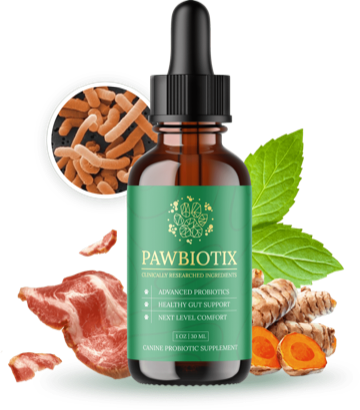
PawBiotix is one example of a daily dog probiotic you might evaluate using the criteria above, and it is more useful to treat it that way than as a pitch. According to its official product information, it is an unflavoured powder you sprinkle onto your dog's food as a single daily serving, it pairs probiotics with prebiotic fibre among 13 gut-supporting ingredients, and it is made for dogs of every breed, age and size. Its makers state that the ingredients are tested for purity and screened for contaminants, and it is sold through its official website with a 60-day money-back guarantee.
Read against this article, the useful signals are the ones you would want for everyday support: a dog-specific formulation, prebiotic fibre alongside the probiotics, a clear once-daily serving you follow rather than improvise, and transparent purchase and return terms. What its published information does not do is establish an antibiotic-specific benefit — full strain designations and CFU potency are not published, and nothing here is a claim that PawBiotix is proven to help after antibiotics or to restore a dog's microbiome. If your dog is on medication or recovering from illness, the timing and suitability question belongs with your veterinarian. If you would like to compare options first, our guide to choosing a dog probiotic lays out the criteria, and you can review the current details and package options on the PawBiotix page.

Frequently asked questions
Should dogs take probiotics after antibiotics?
They can be a reasonable, low-risk option for many healthy dogs, because antibiotics disrupt the gut community and probiotics may help support its recovery. The canine evidence is limited and mixed rather than conclusive, and not every dog needs one. It is worth confirming the choice, timing and product with your veterinarian, especially if your dog is unwell or has a health condition.
Can you give a dog probiotics and antibiotics at the same time?
Often yes, but timing matters. Antibacterial antibiotics can kill the live bacteria in a probiotic, so the two doses are commonly separated by a few hours rather than given together. Some veterinarians prefer a yeast-based probiotic such as Saccharomyces boulardii during a course, since it is not killed by antibacterial antibiotics. There is no single universal rule, so follow your vet's and the product's directions.
Should probiotics be given during or after the antibiotic course?
Both approaches are used, and there is no single protocol that fits every dog or every antibiotic. Some owners and vets start a probiotic during the course to support the gut while it is disrupted, separating it from the antibiotic dose; others focus on the period after the course, when the microbiome is recovering. The right approach depends on the dog, the antibiotic and your veterinarian's advice.
How long should a dog take probiotics after antibiotics?
There is no universal duration. Studies show the gut microbiome usually recovers over a few weeks after a course, but the timeline is highly individual and some changes can persist for a couple of months, depending on the antibiotic and the dog. Many owners continue a probiotic through this recovery window and reassess with their vet, rather than following a fixed number of days.
Can probiotics help diarrhoea after antibiotics?
They may help some dogs with mild antibiotic-associated diarrhoea, and this is one of the more plausible uses, though the evidence is stronger in people than in dogs. Probiotics are supportive care, not a treatment for the underlying problem. A dog that is also vomiting, lethargic, passing blood, or that has diarrhoea lasting beyond about 48 hours needs a veterinarian rather than a supplement.
Does every dog need probiotics after antibiotics?
No. Many dogs recover from a course of antibiotics without any supplement, and a probiotic is an optional supportive measure rather than a requirement. It is more often considered when a dog has had digestive upset, a long or repeated course, or a history of a sensitive stomach. Whether it is worthwhile for your individual dog is a good question for your veterinarian.
What should I look for in a probiotic for after antibiotics?
Look for a product formulated for dogs, with named strains, a potency ideally guaranteed through the expiry date rather than only at manufacture, clear serving directions and transparent labelling. Because probiotic effects are strain-specific, the exact strain and formulation matter more than the word probiotic on the front. If your dog is on medication or unwell, choose the product with your vet.
When should I call the vet about my dog after antibiotics?
Contact your veterinarian if diarrhoea is severe, bloody or lasts beyond about 48 hours, if there is repeated vomiting, marked lethargy, signs of dehydration or a refusal to eat or drink, if symptoms worsen, or for any concern in a very young puppy, a senior, or a dog with a health condition. Also tell your vet if the signs began during the course, since the antibiotic itself may need review.
Keep reading
- Dog gut health: a complete guide — how the canine microbiome works and what disrupts it.
- Probiotics for dog diarrhea — acute versus ongoing cases, and the warning signs that need a vet.
- What are probiotics for dogs? — how they work, and why effects are strain-specific.
- Dog probiotic dosage — how much to give, how to give it, and how often.
- How to choose a dog probiotic — the quality signals to check before you buy.
- Are probiotics safe for dogs? — side effects, life stages, and who should check with a vet first.
References
- Systematic review: "Clinical effect of probiotics in prevention or treatment of gastrointestinal disease in dogs." PubMed Central. ncbi.nlm.nih.gov
- "Effects of Synbiotics on the Fecal Microbiome and Metabolomic Profiles of Healthy Research Dogs Administered Antibiotics: A Randomized, Controlled Trial." Frontiers in Veterinary Science (2021). frontiersin.org
- "Application of Probiotics in Cats and Dogs: Benefits and Mechanisms." Veterinary Sciences, MDPI (2025). mdpi.com
- American Kennel Club (AKC). "How Probiotics Work in Every Stage of a Dog's Life." akc.org
- PetMD (vet-verified). "Probiotics for Dogs." petmd.com
- World Small Animal Veterinary Association — Global Nutrition Guidelines. wsava.org
- National Animal Supplement Council — quality, labelling and compliance programme. nasc.cc
- U.S. Food and Drug Administration, Center for Veterinary Medicine — animal food and supplement oversight. fda.gov
Editorial note: This guide is general canine-health education, checked against the sources above. It has not been reviewed by an individual veterinarian and is not a substitute for professional veterinary advice, diagnosis or treatment. If your dog is on antibiotics or unwell, follow your veterinarian's guidance and your product's label rather than relying on this or any other web page. See our editorial policy.
Affiliate disclosure: This website contains affiliate links. If you purchase through them we may earn a commission at no additional cost to you. See our disclaimer.